Truth in Education | by Rhonda Thomas | October 9, 2025
It’s not about education. It’s about global citizenship, behavioral tracking, and control.
UNESCO’s Vision for Global Literacy
UNESCO doesn’t just support reading; it defines what constitutes “quality education.” Under UN Sustainable Development Goal 4 (SDG 4), UNESCO promotes:
- “Equitable access to quality literacy instruction”
- “Global benchmarks and common learning standards”
- “Literacy for sustainable development”
The Science of Reading, when aligned with UNESCO’s frameworks, becomes a tool for:
- Standardization: Replacing local traditions and teaching methods with global norms
- Datafication: Using reading diagnostics and AI to track individual learning profiles across nations
- Behavior Shaping: Embedding values-based education (SEL, DEI, climate fear literacy) under the guise of “literacy comprehension”
In this model, reading is not neutral; it is a delivery mechanism for communist global values and citizen formation.
UNESCO’s “Global Literacy Strategy” (2020–2025) promotes
- “Evidence-based approaches” to reading instruction (which opens the door to Science of Reading-aligned programs)
- Social and emotional development
- Gender equality and inclusivity in literacy content, unhealthy physical perversions
This supports the SoR model not only for phonics, but also as a platform for disseminating anti-Biblical values, especially when embedded in scripted readers, digital content, and AI platforms.
Digital Literacy = Behavior Shaping = Anti-Biblical Worldview
UNESCO’s “Futures of Education” report (2021) promotes AI-driven, personalized learning
Science of Reading is often delivered through:
- iPads and tablets (e.g., Amplify mClass, Lexia Core5)
- Platforms that collect individual-level learning data
- Platforms designed with addictive algorithms
- Assessment tools that feed into global learning metrics dashboards
These tools are then aligned with UNESCO’s Learning Passport (a Microsoft/UNICEF/UNESCO digital ID system for education). As SoR becomes digitized, it’s easily integrated into:
- Biometric profiles
- Global learning records
- Workforce skill registries
Key Individuals and Influencers
Dr. Rukmini Banerji (Pratham, India / Global EdTech advisor)
- Advisor to UNESCO and the World Bank on early literacy metrics
- Supports universal reading diagnostics aligned with SDG 4.1
- Promotes digitized versions of literacy screening, mirroring the U.S. SoR model
Arne Duncan (Obama’s Secretary of Education)
- Promoted Common Core and launched Race to the Top, a $4.35 billion grant competition, pushed standardized early reading benchmarks
- Now affiliated with global education initiatives that support AI-based reading tools
- He helped launch the Collaborative for Academic, Social, and Emotional Learning (CASEL)’s federal partnerships, embedding SEL into national policy language
- Duncan promoted globalized education aligned with UNESCO frameworks
Dr. Linda Darling-Hammond
- Close to UNESCO, SEL networks, and CASEL
- Advocates for equity-based reading instruction and whole-child data dashboards that link reading performance to social outcomes
- During the Obama administration, Darling-Hammond served as a close education advisor, helping shape the Race to the Top grant framework, which rewarded states for adopting Common Core standards and testing consortia
- She frequently tied the standards to global benchmarking initiatives (PISA, OECD) and to goals resembling UNESCO’s SDG 4 (“inclusive and equitable quality education for all”)
Real-World Example: Amplify and UNESCO Goals
- Amplify, a top Science of Reading vendor, markets itself as “research-based” and partners with major global organizations
- Their tools collect formative assessments, track phonemic growth, and plug into MTSS (Multi-Tiered Systems of Support)
- These frameworks align with UNESCO’s goal of equity-based monitoring, where every child is tracked, supported, remediated, and measured for compliance. Their definition of “supported” and “remediated” is to be psychologically engineered to be compliant and relinquish their God-given human rights
The Trojan Horse Effect
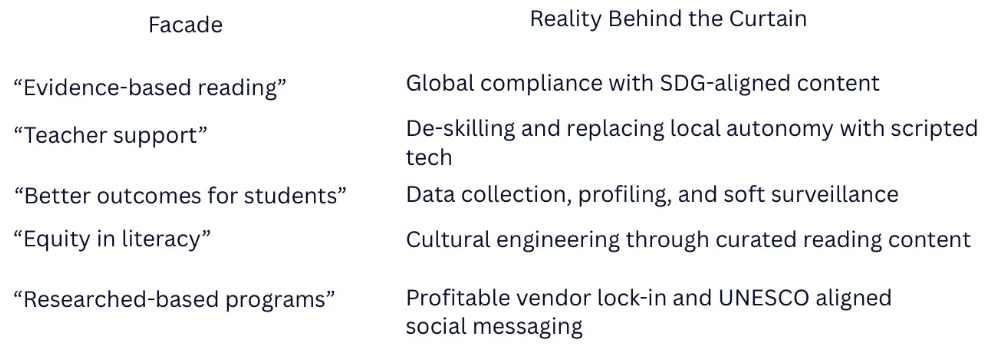
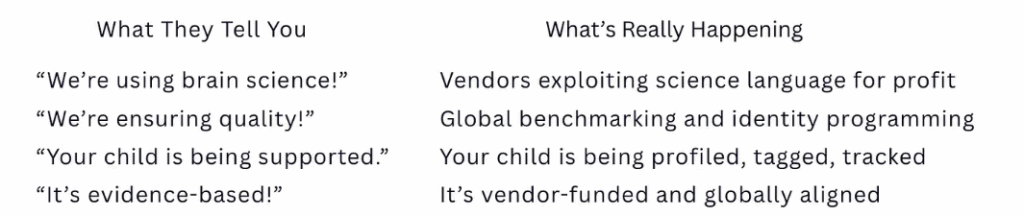
What parents are told: We’re just teaching your child to read using the latest brain science.
What’s Actually Happening
A global infrastructure is being built to track, shape, and credential children, starting with early literacy, and ending with a digital ID linked to their behavior, beliefs, and workforce readiness. Credentialing is submitting to the UN elite dictators to be able to work for a social governance score – slavery.
Summary: SoR as a Gateway to Global Control
Once hailed as a long-overdue return to “real reading instruction,” the Science of Reading (SoR) movement is sweeping across schools in the U.S. and beyond. Parents are told it’s about brain research and better phonics. Governors pass legislation mandating it. Curriculum companies scramble to slap “SoR-aligned” labels on their products.
But behind the slick branding lies a deeper agenda. The SoR is not just a reading reform; it is a globalized, data-driven, and profit-laden Trojan Horse, carrying with it the machinery of behavioral conditioning, teacher de-skilling, surveillance tech, and UN-aligned indoctrination.
Let’s Follow the Trail
What Is the Science of Reading?
At face value, the SoR is a set of practices rooted in neuroscience and cognitive psychology. For marketing, it emphasizes:
- Phonemic awareness
- Phonics
- Fluency
- Vocabulary
- Comprehension
It claims to address reading failure by prioritizing “evidence-based” methods, especially for early literacy. But as with any movement branded with the word science, or evidence-based, we must ask: Whose science? Who profits? And what’s the real goal?
Who Profits From the Science of Reading
The rollout of SoR across states has created a multibillion-dollar opportunity for vendors, edtech firms, and consultants.
- Amplify, publisher of mClass and CKLA, is embedded in districts across the nation
- Lexia Learning (part of Cambium Learning Group) provides phonics and assessment software tied to SoR principles
- Heggerty, Really Great Reading, and countless other companies now sell teacher training, scripted curricula, and digital tools
Under state mandates (such as those in Mississippi, Georgia, and Colorado), school districts are pressured to abandon older curricula, even if they were working, and adopt “approved” SoR vendors. This is not grassroots reform; it is top-down market capture, backed by lobbying, media campaigns, and policy levers.
“When a state mandates a curriculum style, it’s not about helping your child. It’s about securing customers.”
From Decoding to Datafication
While SoR begins with phonics, it doesn’t stop there. Once phonics instruction is digitized and assessment-heavy, it creates a pathway for harvesting behavioral data.
Through apps and platforms, SoR assessments track:
- Eye movement
- Response speed
- Error correction patterns
- Emotional and engagement metrics (in some AI-linked platforms)
This data is then fed into MTSS dashboards, personalized learning plans, and learner profiles (Portrait of a Graduate), often stored in statewide databases or linked to federal and global interoperability frameworks.
Your child’s reading journey becomes a data trail, monitored and monetized.
The UNESCO Connection: Reading for a Global Citizen
Here’s where the mask slips. The United Nations Educational, Scientific, and Cultural Organization (UNESCO) not only supports reading, but it also defines it.
Under Sustainable Development Goal 4 (SDG 4), UNESCO pushes “inclusive, equitable, and quality education for all.” That sounds noble, until you unpack it. Their framework includes:
- Behavioral literacy – tied to sustainability, gender equality, and climate action
- Global benchmarks that override local control
- Digital credentials and learning passports
UNESCO’s Global Literacy Strategy (2020–2025) Promotes
- “Evidence-based reading instruction combined with social-emotional learning, peace education, and values for global citizenship.”
- That’s not phonics. That’s indoctrination via literacy.
AI, Chatbots, and Surveillance: The Next Step
As SoR increasingly relies on apps, assessment tools, and AI-driven instruction, it merges with the UN’s vision of personalized learning ecosystems, often driven by machine learning. In practice:
- Digital learning records follow children across grades and even borders
- AI tutors begin to “diagnose” reading issues and make intervention decisions
- SEL algorithms assess how a child feels about what they read
This isn’t just reading – it’s conditioning, profiling, and behavior modification. Welcome to Reading as a Service. The phrase “Reading as a Service” is a newer term that borrows from the tech concept of Software as a Service (SaaS), meaning reading is being turned into a data-driven digital service rather than a purely educational or personal activity.
Why Parents Must Wake Up
The SoR isn’t just about helping your child read better; it is about restructuring the education system.
What Can Parents Do
- Rescue your child from the indoctrination of public schools and nurture their heart and mind through Christ-centered home education
- Demand transparency: Ask who is spearheading your district’s SoR rollout
- Follow the money: Research vendors and their global affiliations
- Protect your child’s data: Opt out of unnecessary assessments and digital platforms
- Reject one-size-fits-all mandates
- Question the source: If UNESCO, CASEL, or the World Economic Forum endorses it, it’s not neutral
Final Thought
When phonics becomes a pipeline for profit, global governance, and psychological control, it’s no longer just about reading; it’s about reprogramming the next generation.
SOURCES
UNESCO (2021). Futures of Education: Reimagining Our Futures Together. https://unesdoc.unesco.org
UNESCO (2020). Global Education Monitoring Report.
Amplify (2023). What Is the Science of Reading? https://amplify.com/science-of-reading
Lexia Learning (2022). Our Commitment to the Science of Reading.
Banerji, R. (2020). Teaching at the Right Level. World Bank Blog.
Darling-Hammond, L. (2020). Whole Child Equity Indicators. Learning Policy Institute.
United Nations (2015). Transforming Our World: The 2030 Agenda for Sustainable Development.
SDG 4.7 (Education for Sustainable Development and Global Citizenship). https://sdgs.un.org/goals/goal4