Truth in Education | by Rhonda Thomas | August 23, 2026
Reading Through the Lines of Public School Graduate Illiteracy
Teachers face pressure from their school districts to artificially inflate student grades, masking the rising illiteracy of public education graduates.
As test scores and literacy rates are declining in the United States, teachers are sounding the alarm about yet another problem in public education—the pressure to change and artificially inflate grades. While parental requests for grade changes are nothing new, teachers are now being instructed by their school districts to comply.
Samira Hardcastle, a former Tennessee Teacher of the Year, recently left the profession after she refused to change a student’s grade and then watched as the school district changed it due to parental pressure. Ms. Hardcastle stated that, in addition to parental pressure, “it works out for the district because it makes our scores look better.” She also said teachers comply with district grade-change policies out of fear of retaliation: “A lot of teachers can’t speak up because they’re afraid of … having something happen to them.”
While outright pressure to change grades may be the most recent wave of public education disclosures, the concept of inflating grades is not new. Recently, Harvard faculty members overwhelmingly voted to support a new initiative that would cap A’s at 20% of the enrolled student population, effective in the fall semester of 2027. This move comes as data provide a clear example of grade inflation: more than 60% of grades received by Harvard undergraduates in the 2024-2025 academic year were A’s.
Pledge a Tax Deductible Donation
Even as Harvard has moved to tackle grade inflation head-on, other institutions, such as the University of Michigan, have implemented “grade covering” programs in which first-year students in certain majors will no longer have their first-semester grades count toward their cumulative grade point averages. While the university describes the policy as an effort to address the growing mental health crisis among new students and allow them time to acclimate, others point to it as yet another indication that students are not academically prepared for the rigors of college-level work.
University professors are on the receiving end of high school grade-inflation policies, and many have begun to speak out about the illiteracy of the newest generation of incoming students. Professors are having to accommodate students in ways that would have been unthinkable a generation ago—assigning less reading so as not to overwhelm students; reading assigned materials in class together prior to discussion; assigning the same texts repeatedly throughout the year; and adjusting assignments to reduce anxiety and improve grades.
These professors are not alone in voicing their concerns about student illiteracy and grade inflation. Data show that even as graduation rates increased from 74.7% in 2005 to 87% in 2022, literacy rates are decreasing. A recent study cited by the National Literacy Institute found that 21% of U.S. adults had low literacy skills in 2024, with 54% below a 6th-grade level and 20% below a 5th-grade level. Of particular concern is that the 4th-grade literacy rates are also declining, with only a 34% proficiency rate as of 2025. As students are receiving inflated grades and being pushed through the public education system, their post-graduation literacy rates are beginning to appear in national statistics, with strong indications that the worst is yet to come.
Photo credit: The Global Statistics
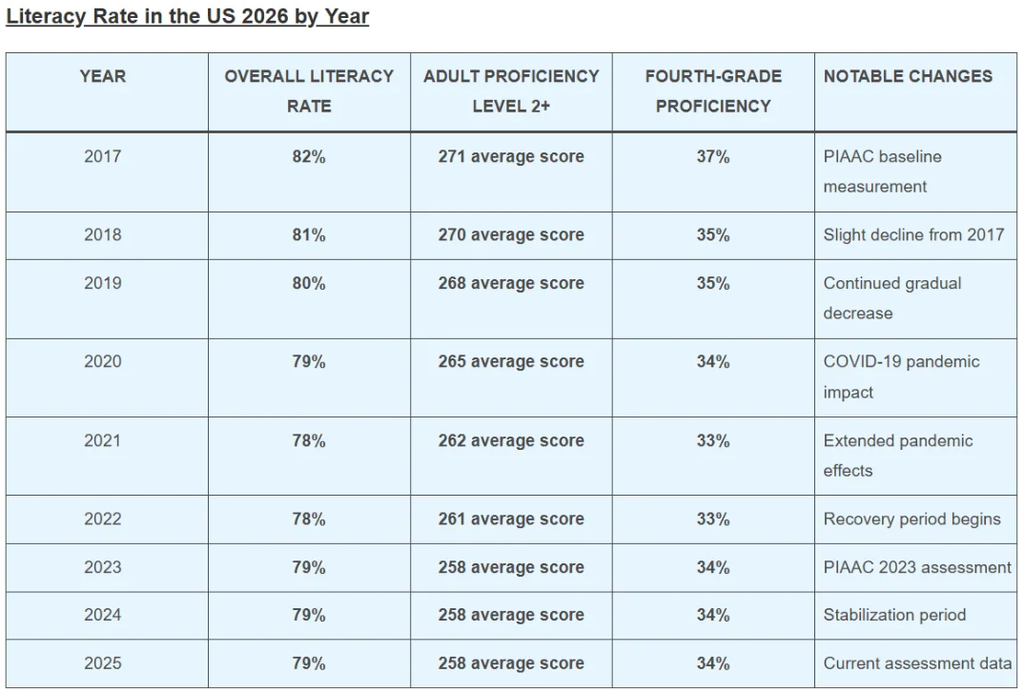
High school illiteracy has become such a contentious issue that students are even filing lawsuits against their school districts for failing to educate them in this basic life skill. Cornell Law School professor William Jacobson shares his insights that these lawsuits are only the tip of the iceberg: “We’ve created incentives for particularly public school systems to just push students along and not to hold them accountable.” He explains that one major cause of this phenomenon is that money is often tied directly to student performance, creating an incentive for school districts to manufacture the appearance of success through inflated grades, graduation rates, and test scores.
Teachers are speaking out about the problems and pressures they face at the hands of a bloated and dictatorial public education system. Perhaps it is time to listen.