

Child Protection League | April 13, 2026
“Not all readers are leaders, but all leaders are readers.” – Harry S. Truman
We came across an article the other day called The average college student today.
Written a year ago, the problems this professor describes are deeply troubling. He has been teaching at the university level for over 30 years. He describes his “average” college students as “functionally illiterate.” Reading “bores them.” Their writing skills are profoundly abysmal:
Spelling is atrocious, grammar is random, and the correct use of apostrophes is cause for celebration. Worse is the resistance to original thought. What I mean is the reflexive submission of the cheapest cliché as novel insight.
He wrote that the students “cheat.” All the time. They use AI to write their papers because they won’t read the material. He describes them as “checked-out, phone-addicted zombies.” “They can’t make it an hour without getting their phone fix.” Which means they rarely sit through an entire class. They leave to go check their phones and often don’t come back.
In fact many just never return to class at all. He wrote:
Students routinely just vanish at some point during the semester. They don’t officially drop or withdraw from the course, they simply quit coming. No email, no notification to anyone in authority about some problem. They just pull an Amelia Earhart.
His experience comports with what we are all hearing. It’s a manifestation of a problem that begins in middle school and quickly becomes the pattern of life. The habit. The addiction. And disinterest in real life.
Some are alerting Congress to the problem as well.
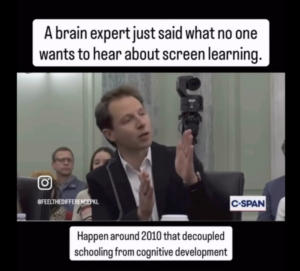
Listen to this 3 minute Congressional testimony discussing the strong correlation between student cognitive decline and the adoption of tech in schools.
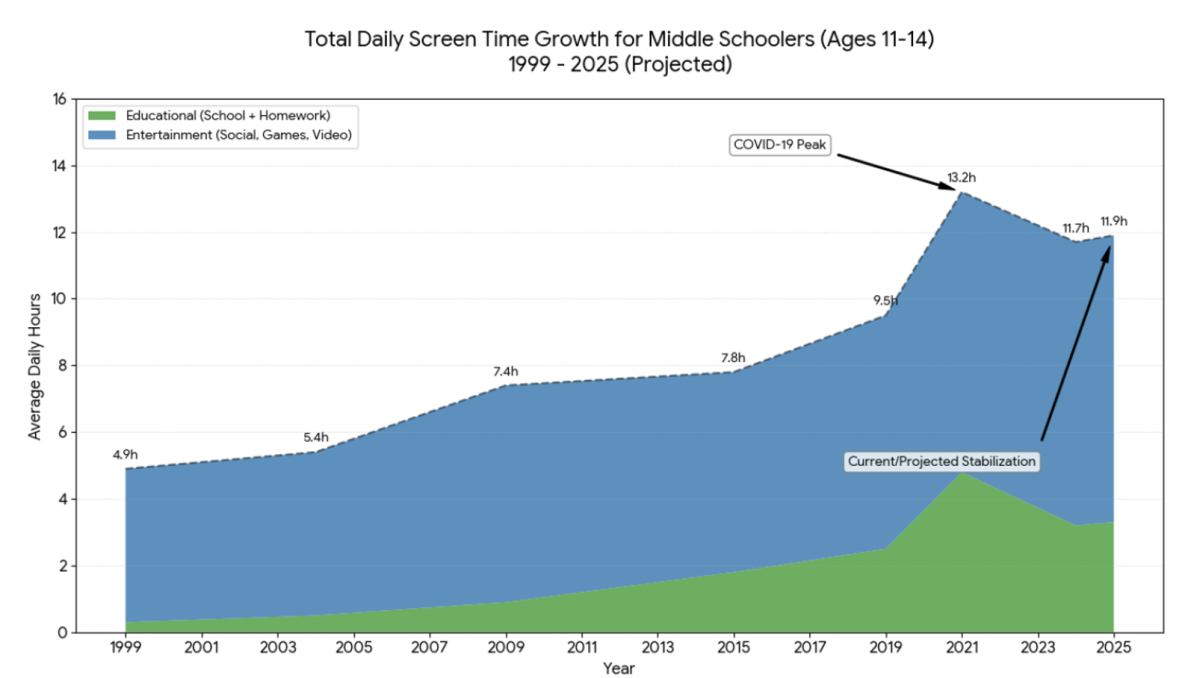
The average American middle schooler now spends nearly nine hours a day tethered to a screen for entertainment alone. When you include their digital screentime while in class or for completing homework, that number increases to almost 12 hours daily. Thus, 75% of their waking life is filtered through their handheld device that rarely leaves their side or a laptop. This shift fundamentally changes how the brain processes and absorbs information.
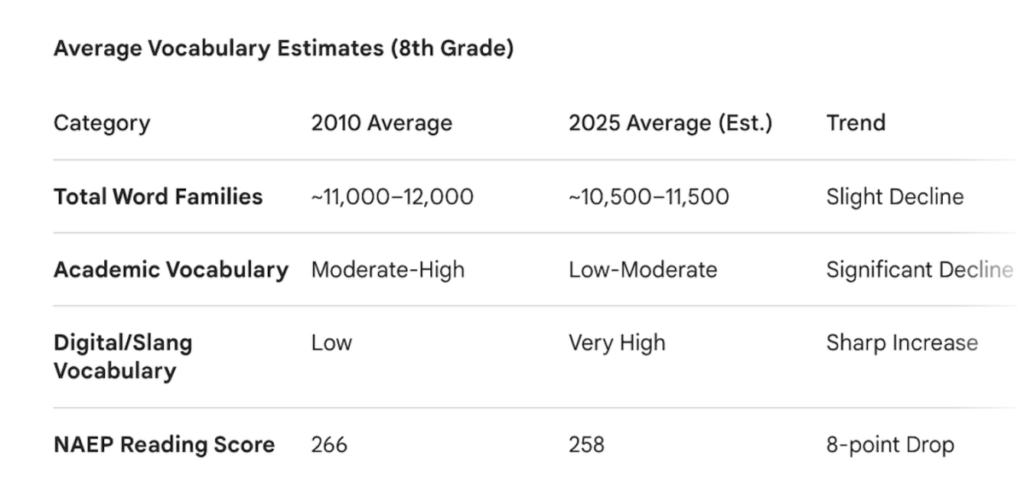
Since 2013, reading scores for 8th graders have plummeted to historic lows, representing the loss of nearly a full year of academic progress. We are witnessing a silent transition from linear reading to tabular scanning—a shift that is physically rewiring the adolescent brain.
The “Skip-It” Habit: Why Vocabulary and Comprehension is Vanishing
In 2010, the average middle schooler could use sophisticated “Tier 2” words like analyze, contrast, and maintain. Today, educators report a widening “Academic Word Gap.”
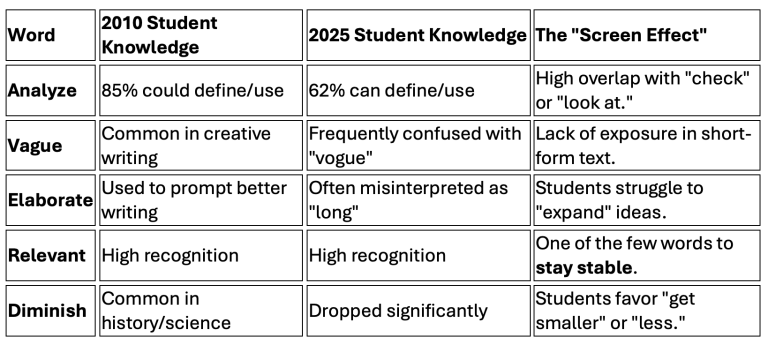
- The Comprehension Gap: Studies indicate a “Screen Inferiority Effect,” where students can identify basic facts but fail to grasp abstract themes or inferential meaning when reading digitally.
- Cognitive Offloading: Constant access to search engines and AI leads to “digital amnesia.” Middle schoolers are increasingly treating information as something to be found rather than known, which prevents the formation of a robust long-term knowledge base schema. Remember the old idiom…you “learn what you teach” holds true. If research and compilation are done by machines, comprehension of how to organize the material in a logical and coherent way for someone else to understand it is fundamentally lost.
- The “Skip-It” Habit: As noted in recent 2025 data, roughly 76% of students just skip over unfamiliar academic vocabulary while scrolling. This creates a “word gap” that severely limits their ability to engage with high-level college or career-track texts later in life. Students are 4x more likely to skip a challenging word on a screen than in a physical book.
- This has led to a Receptive Gap, where students might vaguely understand a word when they see it but can no longer correctly use it in their own writing or speech. Functional vocabulary is not literary rich which only feeds the vacuum of dumbing down their language.
A Crisis of Fragmented Attention and Attention Deficit.
Recent 2026 data from the University of North Carolina (UNC) highlights a startling “compulsive engagement” problem during school hours, meaning students are constantly “checking” their phones throughout the school day. The study found:
- Middle schoolers spent nearly one-third of their school day—about 20 minutes of every hour—on their phones, even during active instruction.
- The average student checked their device 64 times during school hours.
- The frequent “pickups” or “check-ins” are linked to lower activity in the prefrontal cortex, the region of the brain responsible for deep focus and impulse control.
- Habitual Checking: Constant social media notifications condition the brain to become hypersensitive to social rewards, undermining the ability to engage in goal-directed learning.
From the article:
“What surprised us most was the sheer amount of time teens are on their phones during school,” said Kaitlyn Burnell, research assistant professor at UNC-Chapel Hill and co-author of the study. “Students were on their phones every hour during school, spending one-third of the school day on their phones, with social media and entertainment accounting for over 70% of their time.”
By capturing phone use moment to moment, the researchers were able to identify frequent checking, not just total screen time, as a critical behavior linked to attention fragmentation and weaker self-control. This distinction is important, as it suggests that interruptions caused by repeated phone checking may be particularly disruptive to learning.
The inferiority of Screen Reading
There is a persistent myth that digital reading is “just as good” as print. Research proves otherwise through what scientists call the “Screen Inferiority Effect.”
- Abstract vs. Concrete: While students can often recall basic facts from a screen, they struggle significantly to grasp overarching themes or draw complex inferences.
- Metacognitive Overconfidence: Students often believe they understand digital text better because they read it faster, but objective tests show their actual comprehension is lower than when reading slower in print.
- Attention Deficit: 83% of teachers report that student “reading stamina”—the ability to focus on a long text—has decreased significantly since 2019. We see this ourselves. We at CPL still tend to produce long form articles and understand the attention span is shrinking. Brains are being trained for ‘bursts’…not marathons.
- Shallow Brain Effect: Maryanne Wolf and other researchers describe digital reading as “skimming to inform” rather than the “deep reading” required to build analogies, draw inferences, and engage in critical thinking.
Safety and Psychological Risks
The Scrolling 2 Death podcast and similar organizations explore the darker societal consequences of this “always-on” digital culture.
- EdTech Risks: Beyond just academic decline, there is growing concern regarding the privacy and safety of “EdTech” (educational technology) and AI-powered devices in schools, with some parents opting out of school-issued Chromebooks due to these risks.
- Mental Health: Smartphone addiction in schools and higher levels of academic anxiety and lower GPAs is directly correlated.
- Read our recent article about the Meta lawsuit. Two states have found Meta guilty of negligence and child endangerment. The platforms do not protect children from exploitation.
The “Disappearing Top” of Literacy
The National Assessment of Educational Progress (NAEP) reveals a “hollowing out” of high-level literacy and a shrinking vocabulary.
- Proficiency Drop: In 2013, 36% of 8th graders were considered “Proficient” readers; by 2025, that number dropped to below 30%.
- The “Below Basic” Surge: Approximately one-third of all 8th graders now score “Below Basic,” meaning they struggle to identify even the main idea of a simple text.
What about Typing vs Writing?
Research consistently shows that writing by hand engages the brain more extensively than typing. In 2024, the Norwegian University of Science and Technology (NTNU) used high-density EEGs to compare brain activity during handwriting versus typing.
Print or cursive handwriting triggered elaborate brain activity and connectivity patterns across multiple language areas, including memory retention, conceptual understanding, and imaginary visualization. Handwriting is slower than typing and typically forces the brain to paraphrase and summarize what is being transcribed or conceptualized. Similar studies showed that children who formed letters by hand exhibited better letter recognition than those who typed their letters and this kind of recognition is key in learning to read.
In contrast, typing exhibited significantly less brain activity. Screens and repetitive motions provided far less sensory stimulation than writing something down on paper.
Call to Action – How to Reclaim the Adolescent Mind
Since literacy is the foundation of societal participation and success in life, we must take it very seriously and cultivate it.
To reverse these losses, we should NOT move toward a more digital classroom. We must return to intentional, distraction-free learning. We must get kids off their phones during class time and as much as possible during the day.
- Prioritize Print Preservation: Build a library of great and classic books. Aim for physical books with old publication dates that have escaped the long censorship knives of the DEI, CRT and equity anarchists who have been methodically stripping literature of historical language they find “offensive.”
- Challenge the 1:1 Fallacy: 1:1 Tech means all students are provided with their own personal mobile computing device. Challenge the assumption that more tech equals more learning. Tech referendums for schools not only cost taxpayers a lot of money, data shows that same tech costs our children their ability to think also. Push for expanded teacher-led instructional time and discussion instead.
- Don’t let kids have cell phones in the classroom. Full Stop.
- Encourage Boredom. We used to call this daydreaming. Doom scrolling, entertainment, and dopamine hits prime the brain for constant outside stimulation. But moments of thinking…contemplation…have produced some of the most significant advances and ideas. The human imagination is unlimited. But, when every moment is distracted by a flickering screen, we are no longer processing…we’re just watching.
- Teach your littles to read and write. Children should learn to read using phonics and forming their letters and words by hand.
- Delay access and use of devices. The Tech founders like Steve Jobs, Bill Gates and Mark Zuckerberg are famous for enforcing strict device and screen time limits (sometimes NO screens) for their own children. They are acutely aware of the capabilities of their own technology.
- Put down the phone and pick up a book.
- Get kids outside moving, exploring, collecting, playing etc. Leave all the phones behind.
- Discourage the “I must document” everything culture. And practice it yourself.
- Carve out phone-free days with your family and protect them. Our kids are watching what we do too!